
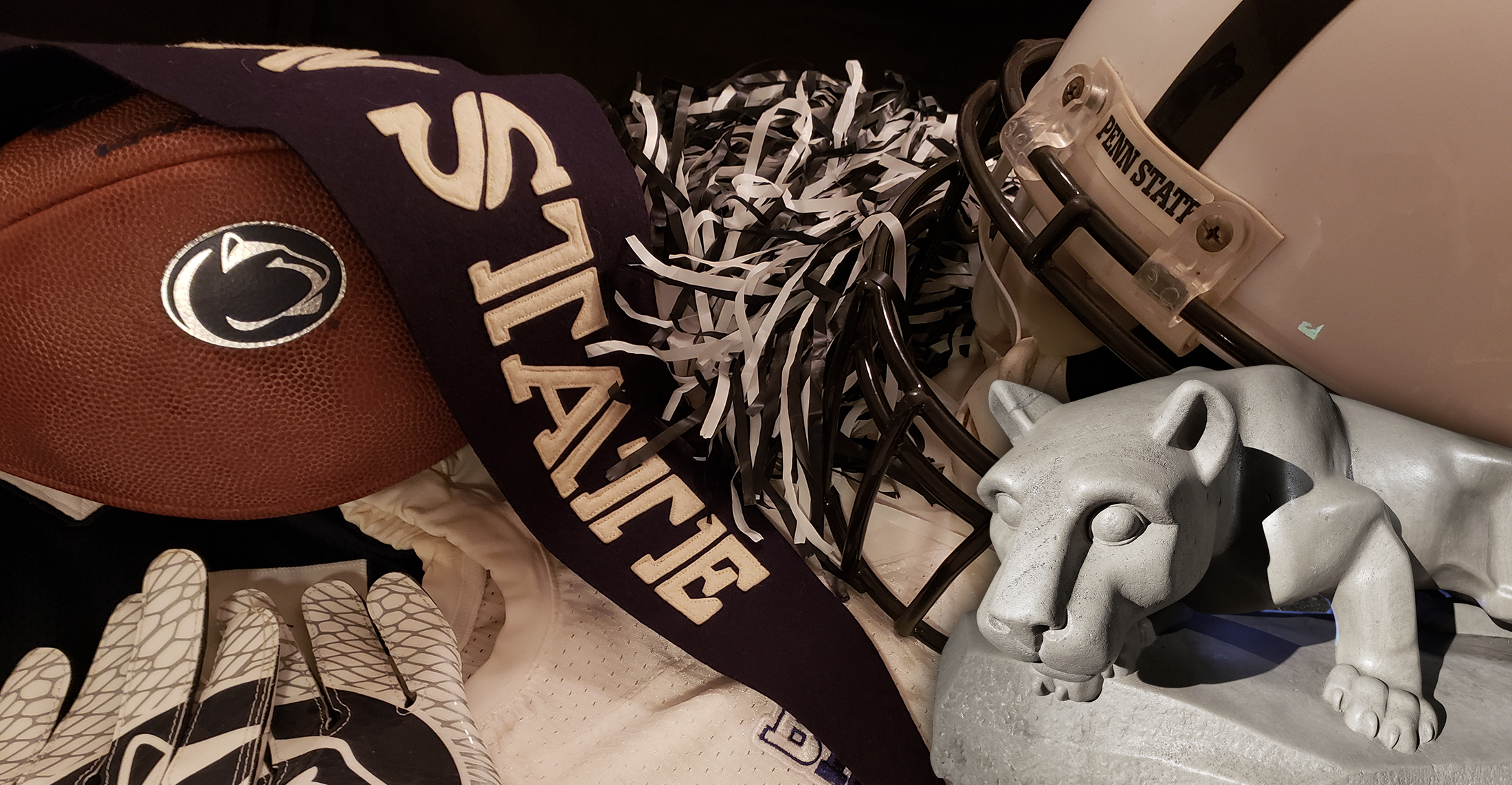
We Are… Penn State
The True Story of the “We Are” Cheer—
Penn State’s now iconic “We Are… Penn State” cheer is not as old, nor tied to any “historic” moment, as some would lead you to believe. Quite simply, it’s a cheer with response concocted by the cheerleaders of the mid-1970’s that was meant to connect the alumni football fans and their student counterparts in a message of team solidarity and school loyalty. The students yell “We Are” and the older folks respond with “Penn State”. Nothing more, nothing less.
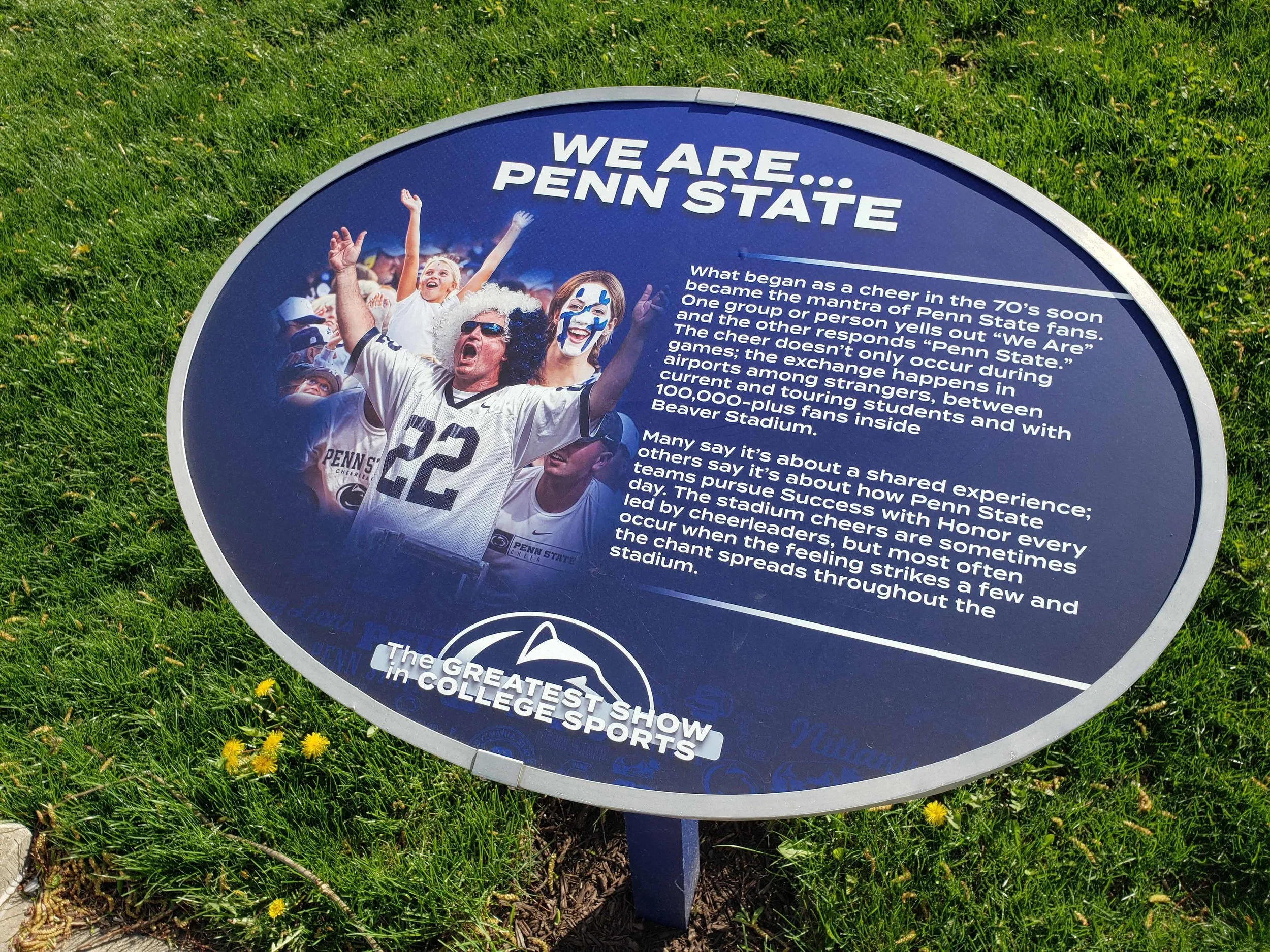
The late Penn State historian, Lou Prato, has written that the cheer dates to the first game of the 1976 football season vs. Stanford, and an oval plaque situated outside the stadium’s southwest corner (near the parking area) also confirms this as a tradition of 1970’s origin (see photo below).
Penn State’s first “official” use of the “We Are… Penn State” slogan appears to be its use as the title for the 1978 football season highlights film narrated by the Nittany Lions’ football voice of that era, Fran Fisher.
But, what about the story revolving around the 1947 football team and the claim that Nittany Lion lineman Steve Suhey used the words “We are Penn State” when rallying the team to stand united in demanding that the Cotton Bowl accept Penn State’s two black players (Wally Triplett & Dennie Hoggard) or the white players would all refuse to play in that game?
Well, Suhey is believed to have said something along the lines of “there will be no meetings… all of us go or none of us go” (the specific words are lost to history—and sometimes adjusted to fit a modern narrative) to unite the team because every last one of them made the trip to Texas and agreed to housing on a nearby military base due to ongoing segregation in the city of Dallas; and the bowl saw its first black players take the field on Jan. 1, 1948. To its credit, SMU agreed to play the game. And Penn State halfback Wally Triplett (future Cotton Bowl Hall of Famer) scored what would be the tying touchdown in the 13-all battle with SMU on a 6-yard pass from Elwood Petchel in the 3rd quarter. Petchel faked a run and found Triplett wide open in the back left corner of the endzone (the kick for the point after touchdown by Ed Czekaj was “controversially” ruled no good).
Somewhere along the way, news media (notably ESPN—see at bottom) picked up on the 1947 historical narrative version of “We Are”, and ran with it, as has Penn State itself, at times. Even Wally Triplett referred to it in interviews in the 2000’s. It’s become a classic case of “don’t let the facts get in the way of a good story”. But the truth is, the 1947 tale has no known basis in fact.
What about “We are Marshall?”
The 2006 film about the November 1970 plane crash tragedy that decimated the Marshall University football team, and its 1971 rise, seems to suggest the “We are” cheer may trace its roots to West Virginia and not State College.
Frankly, this is a case of Hollywood adjusting history to make a better movie script. The Marshall fans do use a “We are” cheer (as do a number of other colleges), but media sources that cover the Thundering Herd football program date the beginning of “We are Marshall” to the early 1980’s. In fact, Jack Lengyel, the coach who led the re-birth of the Marshall program, has said that the “We are Marshall” chant has no ties to the aftermath of the 1970 tragedy.
NOTE: Penn State interestingly has some ties to Marshall’s coaching search that followed the 1970 disaster. Long time Penn State assistant Bob Phillips reportedly declined the job and, before Lengyel was hired, Dick Bestwick (who later coached at Virginia 1976-81) actually held the job for less than a week before quitting and returning to Georgia Tech as an assistant. Bestwick was a grad student at Penn State in the early 1950’s.
Nittany Notes:
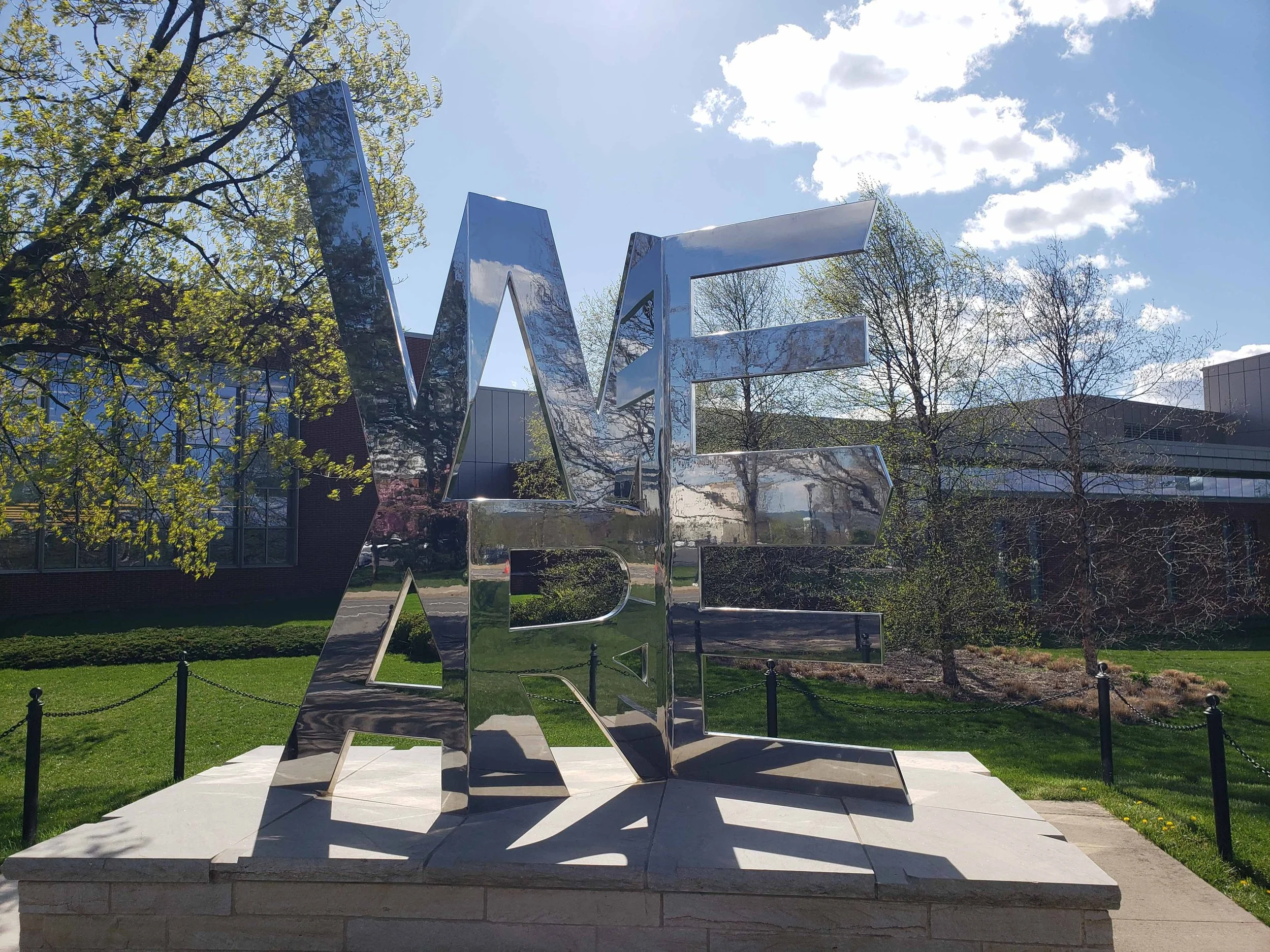
The “We Are… Penn State” cheer is commemorated with a mirrored sculpture along Curtin Road across from the Bryce Jordan Center (see photo above from April 2024). The sculpture of polished stainless steel first appeared on campus in 2015. It is the creation of Jonathan Cramer (PSU Class of 1994, BFA in Art) and is a gift of the Penn State Class of 2013. The steel was donated by ATI Materials.
ESPN produced a short “30 for 30” documentary (which premiered in April 2016) called “We Are” which revolves around the Cramer sculpture and the story of Wally Triplett from the 1948 Cotton Bowl. Actor/comedian and Penn State grad Keegan-Michael Key (PSU MFA 1996) provided the narration for the film. The documentary perpetuates the myth of the connection of the familiar “We Are” cheer to the ‘47 football team. Although, it can be agreed that the sentiment behind the slogan “We Are” certainly aligns with the actions of the players on Penn State’s ‘48 Cotton Bowl team.