
Heisman Trophy
The Heisman Trophy at Penn State—
Penn State’s lone winner of the most-coveted individual trophy in college football history was John Cappelletti (Senior Tailback) in 1973. Cappy was part of the undefeated (12-0) Orange Bowl & Lambert Trophy/Eastern Championship team.
Penn State retired his iconic #22 in 2013 on the 40th anniversary of his Heisman season.
John Cappelletti easily outpolled the second and third place finishers combined (John Hicks OG of Ohio State & Roosevelt Leaks RB of Texas). Cappy garnered 1,057 total points to 524 points for runner-up Hicks. The margin of 533 points between first and second was also larger than Hicks’ total. Cappelletti received 229 1st place votes to 114 for Hicks.
Cappelletti’s emotional Heisman acceptance speech at the banquet in New York City (Dec. 14, 1973) is considered one of the most memorable nights in the award’s history. John tearfully dedicated the trophy to his 11-year-old brother, Joey, who had been battling leukemia since 1967. This would later become the basis for the 1977 made-for-TV movie “Something for Joey” (see ‘Nittany Notes’ at bottom).
NOTE: Penn State’s copy of the 1973 Heisman Trophy awarded to John Cappelletti is on permanent display at the Penn State All-Sports Museum at Beaver Stadium (see photo below). Per the obituary of Lou Prato (founding director of the museum 2001-05) which was published in the July-August 2025 issue of Penn Stater magazine, Prato re-discovered the Heisman along with other historic sports artifacts stashed in a “dusty closet” in Rec Hall.
Penn State has had 3 Second Place Finishers in Heisman Balloting—
Richie Lucas QB in 1959—Lucas received 97 1st place votes and was the first serious Heisman candidate at PSU—was a distant 2nd to winner Billy Cannon HB of LSU
Chuck Fusina QB in 1978—Fusina received 163 1st place votes which was actually more than winner Billy Sims RB of Oklahoma received (151 1st place votes)—Sims had 827 points to Fusina’s 750 for a 77-point margin of victory which was then the 5th closest vote in Heisman history (Sims had far more 2nd place votes than Fusina, 152-89)—Chuck is the only runner-up to do this, but two 3rd place finishers have also done it (Tommy McDonald HB of Oklahoma in 1956 and Tim Tebow QB of Florida in 2008) since 1951
Ki-Jana Carter TB in 1994—Carter collected 115 1st place votes and may have been impacted by voting for 4th place finisher Kerry Collins QB (101 1st place votes) which probably split the “east coast” vote—Carter was a distant second to winner Rashaan Salaam RB of Colorado
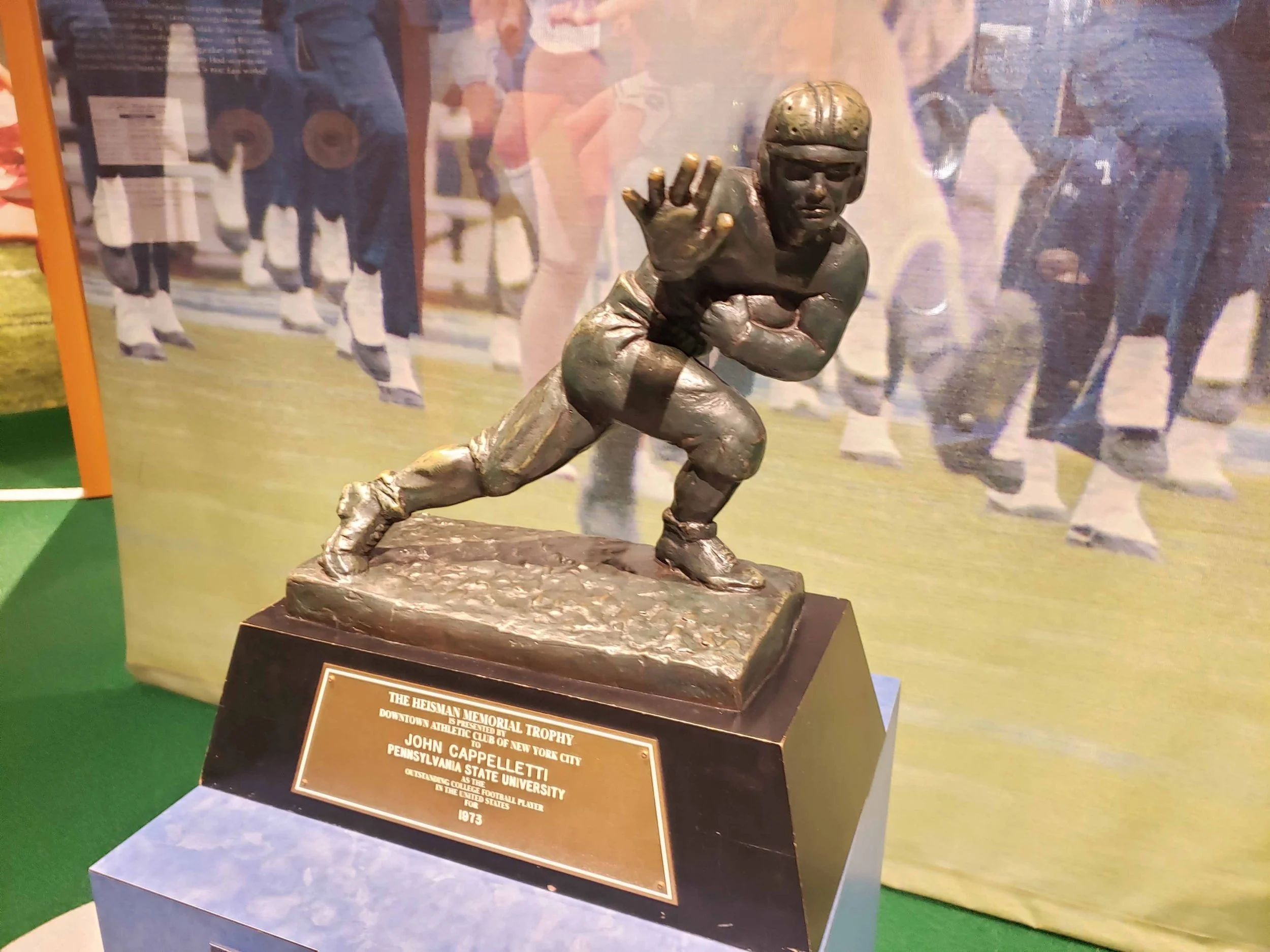
The Heisman Memorial Trophy was first handed out to the top player in college football by the Downtown Athletic Club of New York in 1935. The DAC managed the award through the 2002 season before handing it over to the Heisman Trophy Trust which has governed the award since 2003.
Penn State ties to the Heisman Namesake—
The award was officially named for John Heisman (19th & early 20th century player and coach) in 1936. Heisman faced Penn State once as a player for the Pennsylvania Quakers in the inaugural meeting of UPenn-Penn State in 1890 at the University Athletic Grounds in Philadelphia. Heisman played center in the 20-0 UPenn victory, and the story goes that he suffered permanent damage to his nose when he “leap-frogged” the State center attempting to block a kick. Heisman later coached against Penn State in 1894 while at Oberlin (PS won 9-6) and twice later at UPenn where State won 28-7 in 1920 and lost 7-6 in 1922 at Franklin Field.
Penn State has had 19 Top 10 Finishers in Heisman Balloting (including the 4 above)—
Defensive Players in Blue
Larry Johnson TB was 3rd in 2002 (108 1st place votes)
Ted Kwalick TE was 4th in 1968 (14 1st place votes/winner OJ Simpson HB of USC had 855)
Kerry Collins QB was 4th in 1994 (101 1st place votes)
Saquon Barkley RB was 4th in 2017 (15 1st place votes)
Mike Reid DT was 5th in 1969 (61 1st place votes)
Lydell Mitchell TB was 5th in 1971 (29 1st place votes)
Curtis Enis TB tied for 5th in 1997 (3 1st place votes)
Michael Robinson QB was 5th in 2005 (2 1st place votes)
John Hufnagel QB was 6th in 1972 (62 1st place votes)
Todd Blackledge QB was 6th in 1982 (4 1st place votes)
Tyler Warren TE was 7th in 2024 (1 1st place vote/52 total points)
DJ Dozier TB was 8th in 1986 (0 1st place votes)
LaVar Arrington LB was 9th in 1999 (3 1st place votes)
Curt Warner TB tied for 10th in 1982 (2 1st place votes)
Blair Thomas TB tied for 10th in 1989 (4 1st place votes)
For the Record—
Penn State has had 12 Top 5 vote-getters… 4 Top 10 finishers have been non-RB-QBs (2 TE’s & 2 played defense)… 17 of the players were coached by Joe Paterno as either assistant or head coach and 2 were coached by James Franklin
On two occasions, Penn State placed a pair of players in the Heisman Top 10 in the same season (1982—Blackledge & Warner / 1994—Carter & Collins finished Top 5)
100+ 1st place votes received in Heisman Balloting—John Cappelletti 229 in 1973… Chuck Fusina 163 in 1978… Ki-Jana Carter 115 in 1994… Larry Johnson 108 in 2002… Kerry Collins 101 in 1994… (Richie Lucas 97 in 1959)
The DAC began publicly announcing Heisman Finalists and inviting them to the ceremony in New York beginning in 1982—Since then, five PSU players have been invited to the ceremony in New York City—DJ Dozier in 1986 (did not attend), Blair Thomas in 1989 (did not attend), Carter & Collins in 1994 (both attended), and Larry Johnson in 2002 (attended)—Famously, or infamously if you prefer, Saquon Barkley who would place 4th in the 2017 voting, was not invited to New York by the Heisman Trust in a snub that still sticks in the craw of some Nittany Lion fans.
Nittany Notes:
John Cappelletti’s 1973 Heisman Trophy acceptance speech in which he honored his cancer-stricken youngest brother, Joey, became the subject for the TV movie “Something for Joey” that focused on their relationship amidst John’s football career at Penn State.
The film first aired on CBS-TV on April 6, 1977 (9-11pm ET) and was reportedly the most-watched TV program in the US that week. The movie was produced by Mary Tyler Moore’s MTM Enterprises and was originally sponsored by IBM with only one commercial interruption. Sadly, the film aired almost one year to the day after the death of Joey on April 8, 1976.
Marc Singer (later of “Beastmaster” fame) played the role of John while Joey was portrayed by Jeff Lynas who later became a producer in Canada. The movie was nominated for, but did not win, an Emmy and a Golden Globe. The film also featured Steve Guttenberg (“Police Academy”, “Cocoon”, “Three Men & a Baby”) as brother Mike Cappelletti who also played fullback at PSU (1974-76), and Paul Picerni of TV’s “The Untouchables” as Joe Paterno. University Park served as the backdrop for several scenes. Ironically, when the movie was released on VHS in 1995, it was marketed as a Steve Guttenberg-vehicle since he was probably the most prominent member of the cast at that point in time.
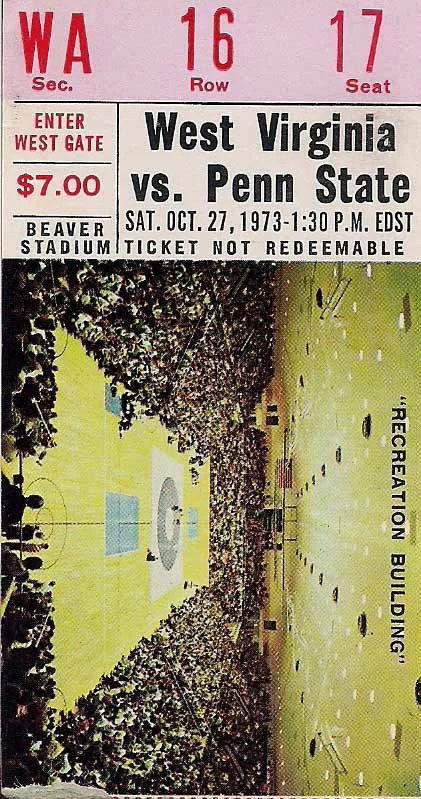
One of the key football stories dramatized in the film stems from the Oct. 27, 1973 game vs. West Virginia in which John rushed for 130 yards and 4 TDs in a 62-14 win. This story was most recently retold in a 2023 Penn Stater magazine tribute to Cappelletti for the 50th anniversary of his Heisman season. (see game ticket below)
The game was a rout, and John had scored 3 touchdowns before halftime, so Paterno decided to sit Cappy for the rest of the game to give his sore shoulder a break (Cappy had only appeared for 3 plays as a decoy the week before in a win at Syracuse due to a partially separated shoulder). Joe was unaware that Joey had asked John to promise that he would score 4 TDs as a birthday present. John never mentioned it to Paterno, but a teammate supposedly told Joe to put John back in the game in the 3rd quarter, and he did, allowing the promise to be kept. The critical fourth TD came from the 2-yard line. Interestingly, this story did not first surface until long after the game but has since been cemented in Cappelletti lore by the movie.
You might not realize it, but you’ve seen one of the Cappelletti TD runs from this game. It’s a highlight reel staple found in almost any video clip of him on the internet. First quarter of a scoreless game vs. the Mountaineers... Just 10 yards, but what a ten yards! Ten yards that truly defined him as a running back… Crashing through the line, breaking a tackle, spinning out of another, and then breaking 4 more tackles to the endzone… West Virginia could not stop him... It was the beginning of the 5-game stretch (800 total yards, 12 TDs) that would win the Heisman!