Blue Band & Penn State Music
Penn State’s Blue Band—
The History
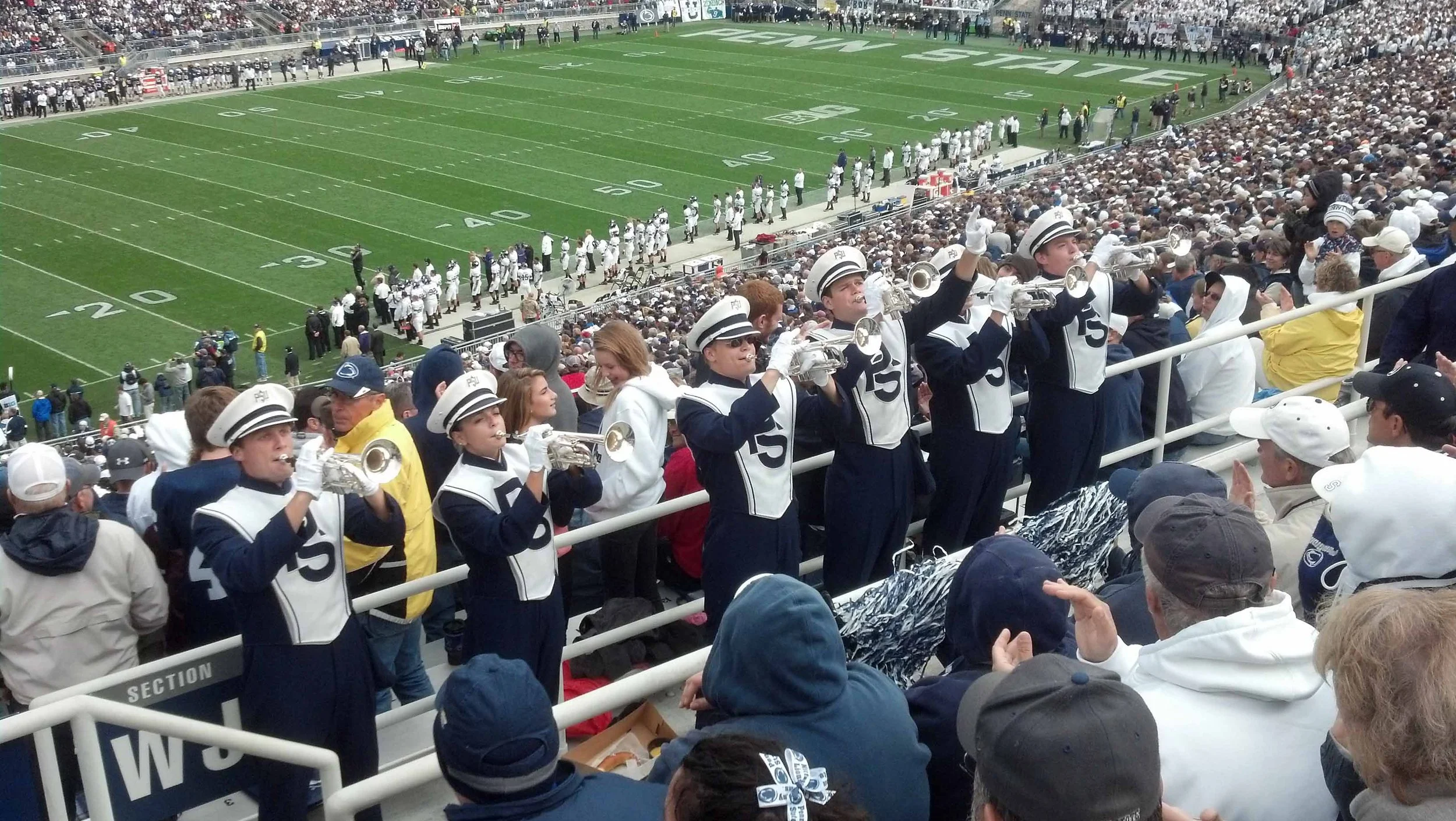
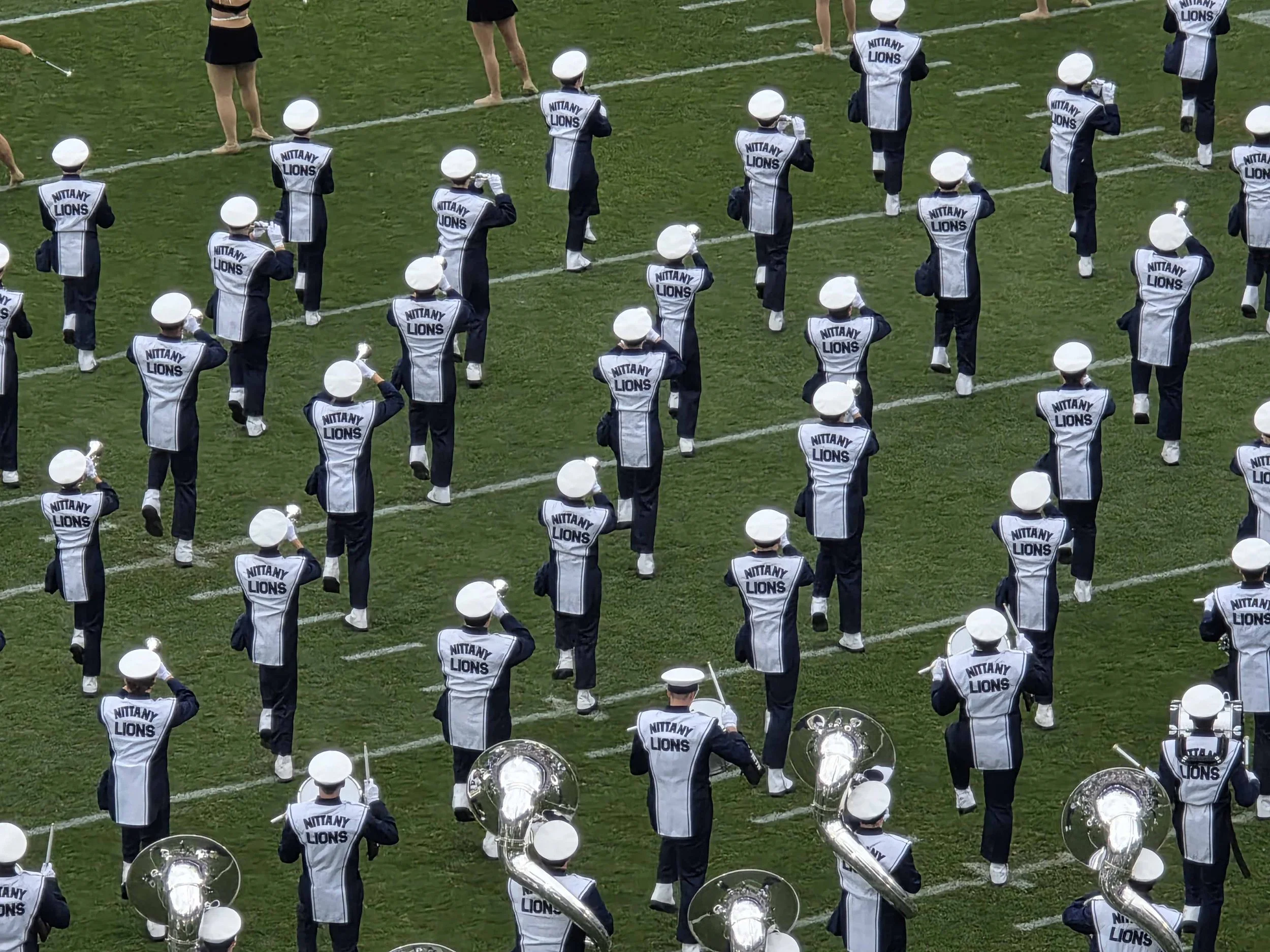
What we now know as the Blue Band dates to 1899 and was originally called the ‘Cadet Bugle Corps’ (and sometimes called the ‘State College Band’ and later ‘Cadet Band’)… It all began with only 4 buglers and 2 drummers… The Cadet Band was funded initially by Andrew Carnegie who provided the school the money for the first library building and who gave the band the money to buy instruments. The Cadet Band began to regularly perform at home football games in fall 1901… It would be renamed the ‘College Military Band’ in 1918 and then officially renamed the ‘Blue Band’ in 1923 with the arrival of new blue uniforms (which have undergone various changes through the decades)…
Blue Band Historical Facts
The Blue Band did not have full-time director until 1914 when Tommy Thompson was named to the role… Prior to that, it was largely a student-run organization…
The first ‘Alumni’ Blue Band performance at Homecoming was in 1964
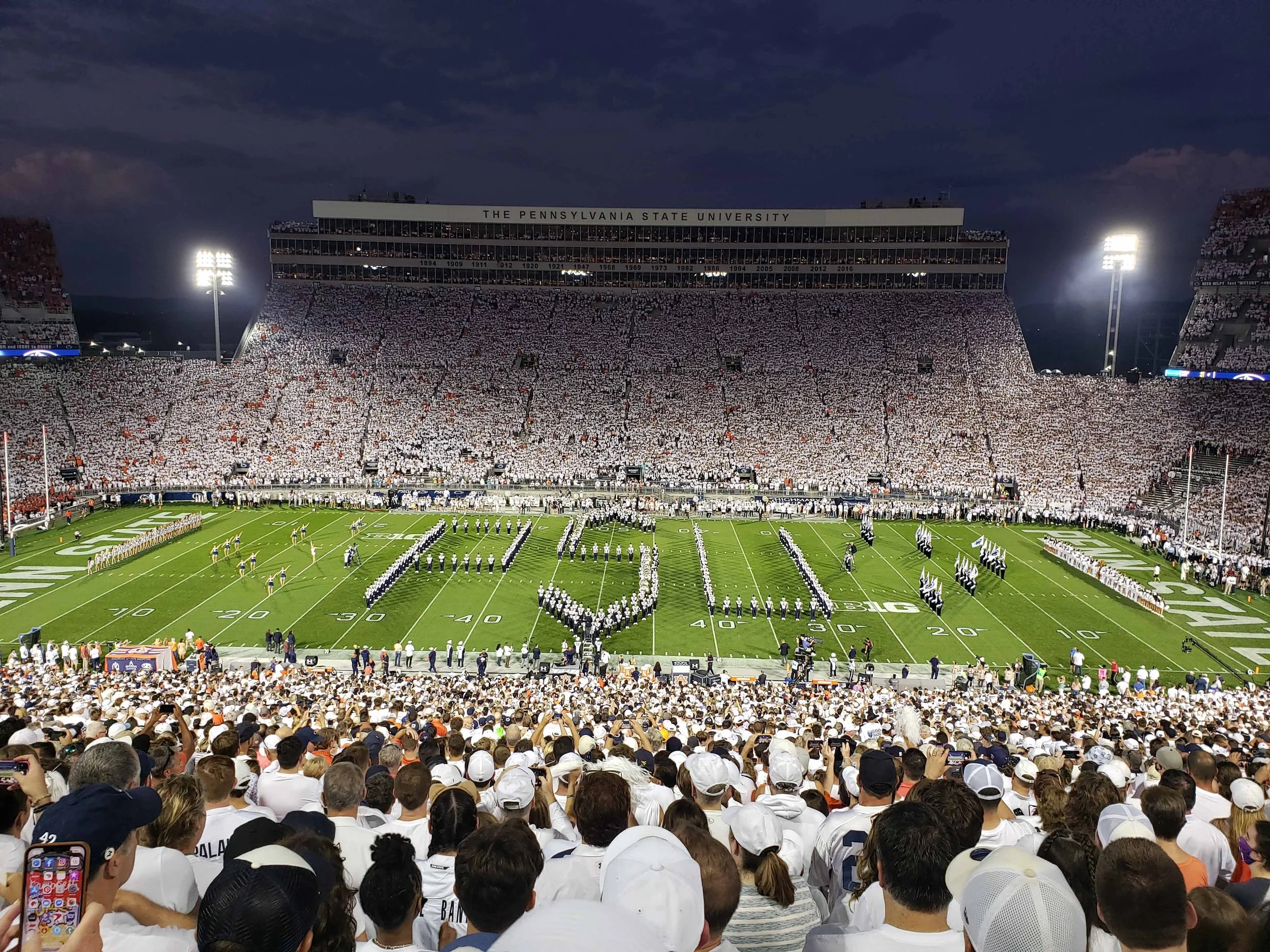
The first appearance of the popular “Floating Lions” pre-game show was in 1965
The Blue Band was a “men-only” instrumental unit until September 29, 1973, when the first women musicians joined for the Homecoming game vs. Iowa… Note: Some women played instruments and participated in the Blue Band in 1944-45 due to the absence of men on campus during WWII… But by 1946, the Band resumed its “men-only” status, and it also resumed marching at games which had not happened since fall 1942 due to “staffing” issues with limited band membership (the sometimes-makeshift band usually played at games in 1943-45, but did not march on the field)… Women musicians were then allowed to join the newly created Concert Blue Band…
Majorettes/Twirlers (now known as the Touch of Blue) had actually debuted with the Blue Band in the 1972 football season and were featured on the cover of the 1972 PSU-Maryland Beaver Stadium Pictorial…
The first ‘Blue Sapphire’ Feature Twirler was Lori Bowers (1978-82)—She replaced the first actual “Feature Twirler” Lori Donaldson…
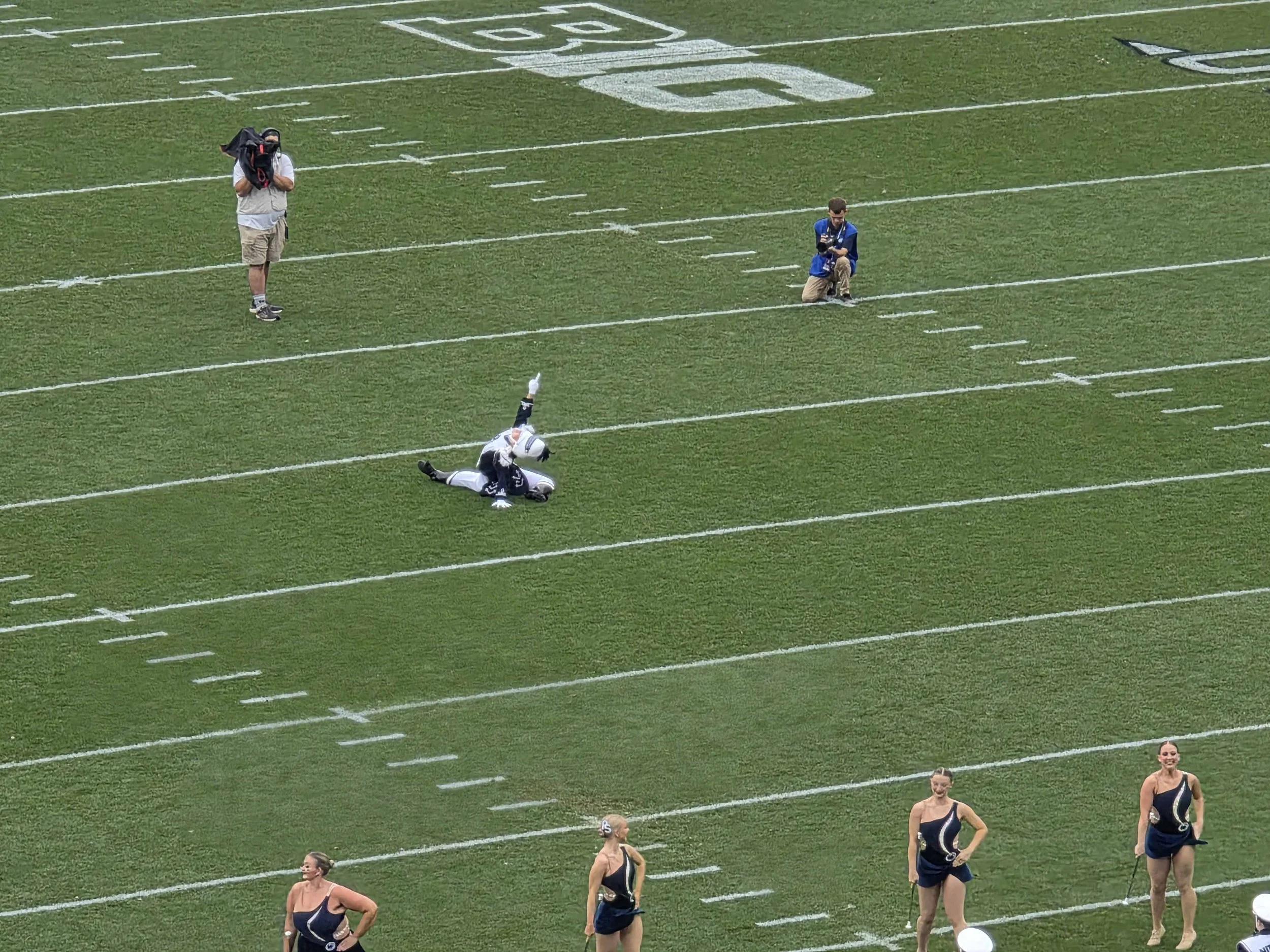
The first of the now familiar (and now mandatory in auditions) ‘forward flips’ by the Drum Major came in the 1978 Rutgers game from Ron Louder (although ‘backflips’ were seen as early as the 1971 Homecoming game vs. TCU with Drum Major Jeff Robertson)—Per a 2023 Penn Stater magazine article, Louder struggled with the backflip in 1977 and switched to the front flip for ‘78….
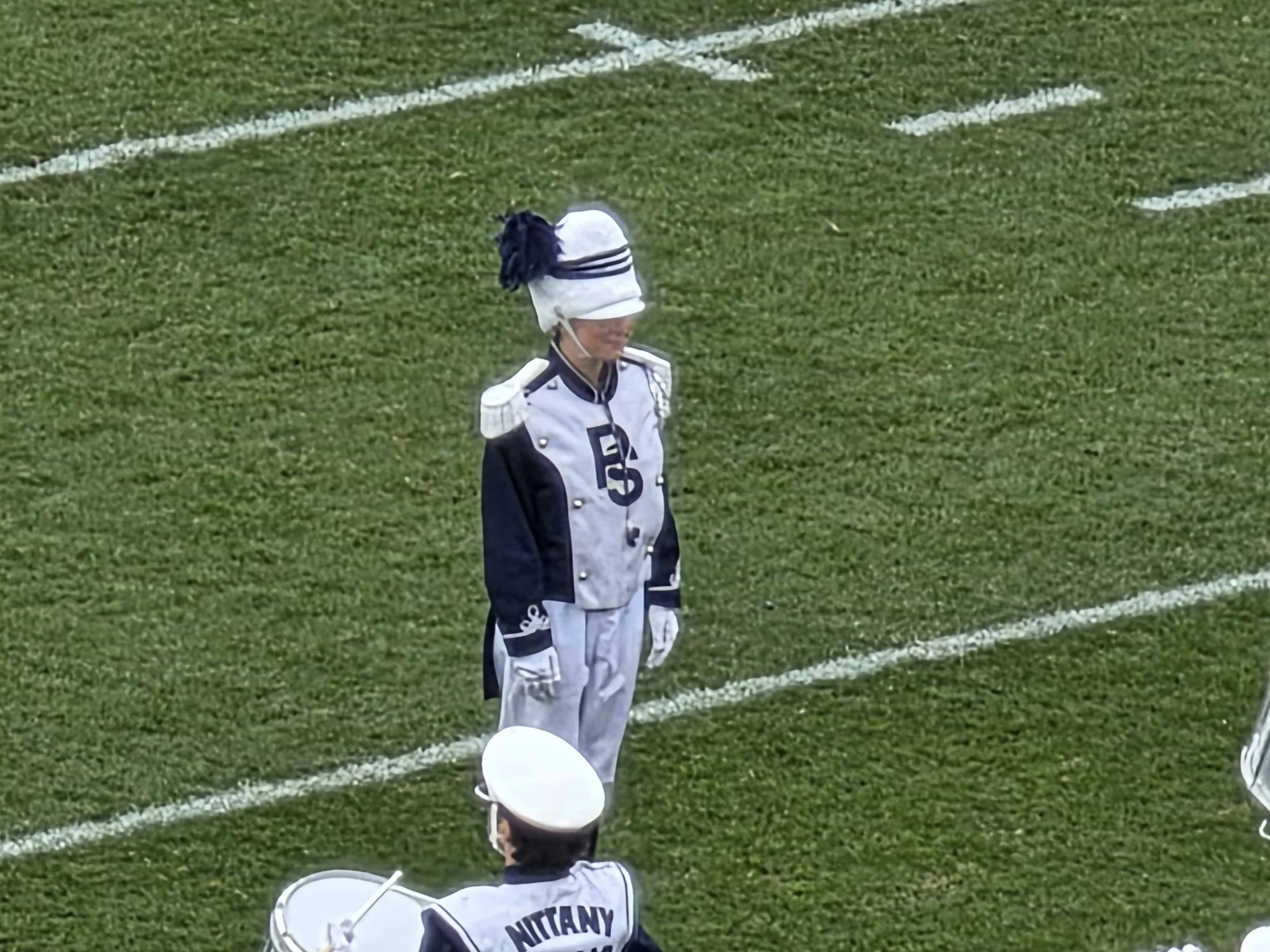
The first woman to appear as the Blue Band Drum Major was announced July 31, 2025, for the 2025-26 season—It was 5th year senior Ellie Sheehan, former piccolo section leader from Hollidaysburg, PA… (see photos of Ellie in 2025 at the very bottom)
Four Interesting Facts about the Blue Band
The Blue Band played (and can be clearly heard playing “Nittany Lion”) in the background of some scenes of the movie “Rudy”… Parts of the movie were filmed at two Notre Dame games in 1992 including the PSU game on a snowy Nov. 14 (this game which was a 17-16 Nittany Lion loss is sometimes remembered as “Snow Bowl I”)…
Something that would never happen in the 21st century… The Blue Band was unable to march at the 1964 season opener vs. Navy which was live on NBC-TV and featured Heisman Trophy winning Midshipmen quarterback Roger Staubach, because the game was scheduled to be played before the start of the fall academic term and Penn State would not open the dorms ahead of time to permit the band to return to campus… Although it did rain that day and the band might not have been allowed to march on the field anyway…
Penn State began using photos on its gameday football tickets in 1960, but the Blue Band was not featured on one until some sousaphone players made an appearance on the 1980 game ticket vs. Pitt…
The Blue Band performed a special song written for the inaugural Liberty Bowl game in Philadelphia, Dec. 19, 1959… The “Liberty Bowl” song was played at halftime of the PSU 7-0 win over Alabama… It was written by Penn State grad and popular band leader, Fred Waring (“Cheer the bowl in fabulous Philadelphia”)… The song didn’t help… The early Liberty Bowls struggled to draw crowds in December in fabulous Philly (even with Penn State playing in the first two), and by 1965, the bowl had relocated to Memphis…


Penn State True-Blue (& White) Classics
Penn State Alma Mater (For the Glory of Old State)—written by Fred Lewis Pattee in March 1901 (published in the student newspaper of the era, The Free Lance) and performed publicly for the first time in June 1901 with the words set to the music of the hymn “Lead Me On” (Composer: Cauviere) which was reportedly published in the college hymnal—The original Pattee work included a total of 6 stanzas (two of which are seldom, if ever, performed)—Words used today include the 1975 Board of Trustees approved changes to the third stanza (of the 4 commonly used) where “boyhood’s gate” becomes “childhood’s gate” and the repeated phrase “into men” becomes “dear old state” repeated—The University and others have suggested that Pattee (who died in 1950) would have preferred the newer words, but he is said to have felt compelled to use “men” in that era even though Penn State was technically a coed school by then
Victory (“A Penn State Song”) (reportedly written in Spring 1912 and debuted at Penn State in Fall 1913)—words & music written by James A. Leyden of the Penn State Class of 1914 (Victory will our slogan be…. Fight on to Victory!)—This was dedicated by Leyden to 1913 Nittany Lions quarterback and captain Shorty Miller—Leyden was a quarter-miler on the track team and supposedly wrote this tune in his room at Track House (the original varsity athlete housing near the site of Old Beaver Field)
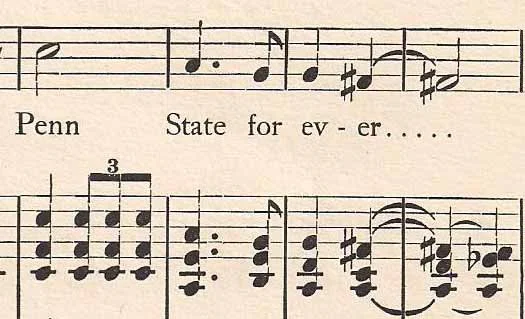
Fight on, State (Penn State’s Official Fight Song)—written by Joe Saunders of the Penn State Class of 1915 (Fight on, State… Roar Lions Roar!)—This song is played frequently by the Blue Band in modified, shorter versions (which date to approximately 1968)—It is commonly played after a PSU touchdown
Nittany Lion (debuted October 4, 1919)—written by James A. Leyden of the Penn State Class of 1914 (Every College has a Legend… Hail to the Lion… Loyal and True)—Early published music sheets were dedicated to the memory of Penn State football players, Levi Lamb and James “Red” Bebout, who had been killed in action in France in 1918 during World War I—This song is most memorably played in pre-game as part of the “Floating Lions” sequence where the Blue Band transitions from its PSU monogram formation to spell out “LIONS” which is then followed by the song Fight on, State
Classic Penn State Music that has fallen into disuse—
Blue and White (Where the vale of old Mt. Nittany meets the eastern sky, proudly stands our alma mater, on her hilltop high)—The words to this song appeared in Beaver Stadium Pictorial programs into the 1970’s
Hail! Oh Hail!—written by Ray Fortunato of the Penn State Class of 1947 (Hail, Oh Hail to Pennsylvania State… Hail, Oh Hail the Blue and White… Shout for Alma Mater’s Glory Mate… And show that we know that we can conquer because of our might… Victory will soon be won again)—This song appears to have been somewhat popular in the 1950’s and early 60’s
When the Blue Band Takes a Break (sort of)—
Penn State fans are also familiar with a number of popular song recordings that have been introduced at Beaver Stadium over the years to create a certain “atmosphere” or just for a “good ole sing-along”…
Beaver Stadium “Atmosphere” Music (21st century)—
Rock & Roll Cheer—The Blue Band (with the fans shouting “P… S… U… Let’s Go… PSU”)—Initially played as team prepares to enter the field through the ‘band tunnel’
Seven Nation Army (2003) by alt-rock duo The White Stripes (Jack White & Meg White)—PSU football reportedly made this guitar riff with drum beat famous in the US-”Dummm… dada da… da… dum… dummm” when it debuted at the 2006 Blue-White Game (although it had been used as a team “song” internationally since 2003 by fans of a Belgian soccer club)
Kernkraft 400 (1999) by Zombie Nation (part of the staccato “We Are Penn State” chant “Oh oh oh oh oh… oh oh oh Oh”)
Uprising (2009) by Muse (alt-rock/space rock English band)—Blue Band uses music-only when part of their repertoire
Zulu language opening chant from Disney’s The Lion King Circle of Life (1994/remix) written by Tim Rice and Elton John and performed by Lebohang Morake (aka Lebo M)-The beginning of the chant in Zulu translates roughly to “here comes a lion…” with the PSU student section standing and holding their white poms in two hands above their heads ala Simba from the animated Disney Lion King movie
Mo Bamba (2017) PSU uses the “barely clean lyrics” version of the song by the rapper Sheck Wes
Joker and the Thief (2006) by Wolfmother (Australian band)
In the Air Tonight (1981) by Phil Collins
Crazy Train (1980) by Ozzie Osbourne
The Beaver Stadium Sing-alongs—
Livin’ on a Prayer (1986) by Bon Jovi
Sweet Caroline (1969) by Neil Diamond (Sweet Caroline was first made famous as a gameday song by the Boston Red Sox starting in 1999 when the team was leading in late innings, and at every home game starting in 2002)—Typically played in the 4th quarter
Hey! Baby (2000) DJ Otzi cover version (remake of the 1961 Bruce Channel release)
Shut Up and Dance (2014) by Walk the Moon
I’m Gonna Be (500 Miles) (1988) by the Scottish duo The Proclaimers
Mr. Brightside (2003) by the Killers