
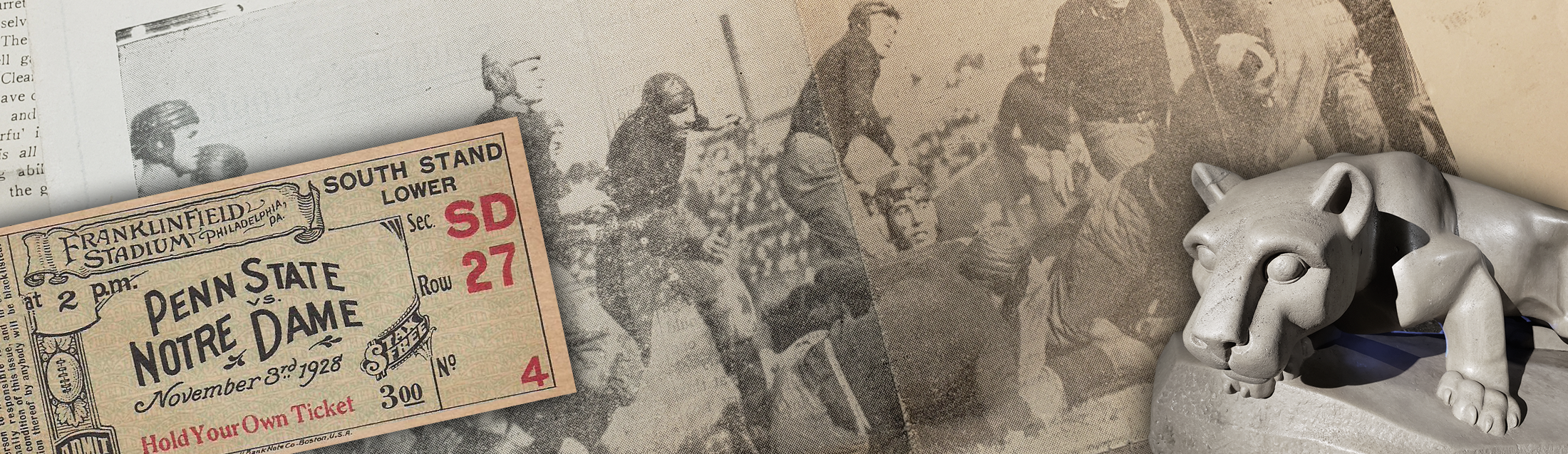
Your Ticket to…
A Great Game!
Statement Games & Message Games

Message Games—
“Message Games” are not statement games, per se, but a friendly reminder to the other team (typically a rival) that Penn State is still a real problem for you… “Penn State still lives rent-free in your head”… Fans of the University of Pennsylvania got that message for the very first time in 1915… In the earliest days of Penn State football there was no bigger rival and no bigger headache than the Quakers of UPenn, one of the top national powers of this era… From 1890 through 1910, UP dominated this series winning the first 15 games in a row and 16 of the first 17 played… The lone bright spot, a 3-3 tie in 1909 along with a pair of close call 6-0 losses in 1904 and 1908… The tide turned in 1909 with the arrival of new State head coach Bill Hollenback, a former star fullback for the Quakers who had scored 3 TDs against the Nittany Lions in the 28-0 UP victory in 1907… Hollenback was the final piece of the puzzle needed to get State into the win column against its Quaker nemesis delivering the first two wins in 1911 and 1912… But, the Hollenback magic faded in 1913, and by 1915 State had a new coach in Dick Harlow, the first former Nittany Lion player to take the helm at State in the 20th century…
1915 at UPenn—We still have your number, even though you still can’t believe it
October 9, 1915, Penn State (2-0 on the season after two shutouts) is once again at Franklin Field in Philadelphia… Every game in this series which would run through the 1958 season was played on the Quakers home field (UPenn never set foot in State College)…. On this day, just like 1911, UPenn fans would be in for quite a shock… Many felt that with Hollenback gone things would return to normal with the complete and total domination of “little brother” Penn State on the gridiron… After all, they had handily beaten the Lions 17-0 in their last meeting with Hollenback at the controls in 1913… Certainly that was a sign of good times continuing in Philadelphia…
With the game, the Quakers held a 3-0 lead at the half… But, in the third quarter, State drove from midfield and Left Halfback Robert “Punk” Berryman (photo below) punched it through the center of the Penn line (or in some contemporary newspaper accounts, “ran around the right end”) for the TD that gave State the lead… A little later, State was at midfield again…. Fullback Jeff Clark dropped back with the snap to the State 45-yard line… He would then deliver the only completed forward pass of the entire game hitting Sophomore Left End Bob Higgins at the Penn 40… Higgins shook off some defenders and took off for the endzone blowing the game open en route to a stunning 13-3 Penn State victory…. This was the first win over UPenn by a Penn State coach who not only did not graduate from UPenn, but actually graduated from Penn State, Dick Harlow… UPenn fans of the era really didn’t really think this was possible…
From there, a series once largely dominated by Penn for 25 years began to level off and become more and more competitive until it ended after the 1958 game with Penn State fans ripping down the wooden goalposts for the final time at Franklin Field… The final 12 meetings (which had become less frequent through the 1940’s) saw State win 10 times with a tie and only one loss… The series was ended by mutual agreement according to contemporary media in fall 1957… But very likely the Ivy League (which formed in 1954) might have been a big factor, too… By 1957, Penn’s days of playing a national-type schedule were over… The Quakers had begun playing a full slate of 7 Ivy League games beginning in 1956, and now had only two open dates in its 9-game schedule for non-conference play, so dropping PSU after the scheduled 1958 game probably made some sense… At that time, no games with State had been scheduled beyond the ‘58 game… There was a hint here and there of resuming the series, but it would never happen…
For Other Message & Statement Game Stories—CLICK HERE
2023 vs. Iowa—The Whiteout Shutout
1995 at Iowa—Hawkeyes on the menu
1975 at Pitt—Not here, not now
1911 at UPenn—Our first true upset victory
—SEE NITTANY NOTES BELOW—

Nittany NOTES:
Penn State football fans in 1915 who could not make, or afford, the $7 round-trip train trek from the State College area to Philly, plus extra for a Pullman sleeping berth or an overnight Friday stay at a hotel (plus food expenses), and also pay the $1.50 game ticket price at Franklin Field, gathered in Schwab Auditorium on the State College campus that October afternoon where for 25 cents (see ticket at very top) they could hear updates announced by megaphone and posted on a gridiron board describing the game action as it came in via a “leased private wire” from a telegrapher in the stands at Franklin Field… The private lines were typically provided by AT&T, Western Union, Postal Telegraph & Cable, or similar… This became known as “Football Telephone Returns”…
The concept of “Football Telephone Returns” is believed to date to the 1903 Michigan at Minnesota game which reportedly used an actual voice “phone call” on a private line from a student stationed in a tower above the 55-yard line of Northrop Field in Minneapolis (this is arguably the first instance of football play-by-play)… Penn State adopted the “telegraph version” of Football Telephone Returns for many key road games (typically Pitt & UPenn) with fans known to have gathered in Old Main Chapel as early as the 1909 season… This would continue into the mid-1920’s before finally giving way to the rise of live game play-by-play on that newfangled invention, radio…
The on-site game telegraph operator would “key” in Morse Code (no doubt using some pre-determined football shorthand and a player numbering scheme—actual jersey numbers were not required prior to 1915, although State wore numbers on their backs as early as 1908 at Pitt) to quickly describe the “live” game action… A second telegrapher (or possibly more than one) at the chapel, and later, the college auditorium would decode the messages and hand them to the megaphone announcer to relay to the crowd on hand… (There were also reported instances where alumni groups, in Pittsburgh for example, would pay for a similar feed from Franklin Field across the state to folks gathered in a hotel ballroom, or similar location)…
Why telegraphy over a “voice” phone call?
Remember, in 1915, the first attempts at a “live radio game broadcast” were still 6 years away and football stadiums were not really equipped for this sort of thing in the “pre-Press Box era” (New Beaver Field, for example, did not have a press box until the early 20’s)… Also, an open telephone line for live voice description via a 2-plus hour phone call would have been prohibitively expensive, if not technologically difficult, at the time… There were limits on how far a voice could actually travel over phone lines and still be understood (and this doesn’t take into account competition with crowd noise from the bleachers)… HISTORICAL NOTE: The first known transcontinental voice phone call was tested in January 1915 (NYC to San Francisco) using hundreds of miles of AT&T copper wire lines, many amplifiers, and multiple switchboards (the cost was estimated at $20 per three minutes in 1915 money—now do the math for a football game and adjust for inflation)…
Telegraphy from the grandstand was simpler and more cost effective when you consider there were no loudspeakers to allow folks in an auditorium to directly hear the “voice on the telephone” coming from the stadium in these early years (Michigan’s 1903 voice report attempt required 10 manned telephones in their auditorium to listen and take turns in making the announcements via megaphone)… In some cases, games in this era would have several telegraphers side-by-side in the stands, furiously “keying” Morse Code to multiple destinations including newspaper offices… Imagine if they had all been trying to make phone calls instead…
Note: Interestingly, the 1921 Penn State game with Georgia Tech at the Polo Grounds in New York saw Nittany Lions fans get their “Telephone Returns” outdoors at New Beaver Field… Ironically, this took place exactly 3 weeks after KDKA in Pittsburgh broadcast the first known college football game live on radio (Pitt vs. West Virginia at Forbes Field with the announcer sitting in box seats using a converted telephone as his microphone)… Penn State’s first “live football game on radio” was still over a year away—the 1923 Rose Bowl Game… The college radio station WPSC would finally begin regular broadcasts of home games in 1927…
Below is an image of the October 1911 Penn State-UPenn gameday program “roster insert” page with the odd-even numbering scheme used to ID players on the manual scoreboard at Franklin Field that day… This was the era prior to both mandatory jersey numbers & stadium loudspeakers, and this concept may have been used to ID players as part of the Morse Code telegraphy in “Football Telephone Returns”…
